
How Rizwan G. Closed the American Gap and Made the Sale
- alverazricardez
- Jan 14
- 3 min read

The deal was going perfectly, until the buyer got quiet and said one strange sentence.
A few minutes later, Rizwan G. reached out to me. He’s a client in my Evolution program, and he’d just finished a meeting with a major U.S. buyer. He could feel the deal falling apart. The American buyer made an odd comment about “playing sports inside somewhere,” then went distant.
I had a strong suspicion what Rizwan meant, but I didn’t want to guess. I asked him one clarifying question: did the buyer use the phrase “inside baseball”?
He did.
And this is where many Gulf region professionals lose momentum with American buyers, especially in regulated industries.
Rizwan sells industrial machinery components used in energy infrastructure. These are high-stakes parts. They require strict ASME compliance and pressure testing certification to clear U.S. customs. In this environment, American buyers are thinking about liability and internal approvals.
In the meeting, the buyer raised a concern about a compliance hurdle related to pressure testing certification. It can be anything from popsicle sticks to engine parts, if you're selling to an American over seas, liability and proof of compliance is at the top of their mind.
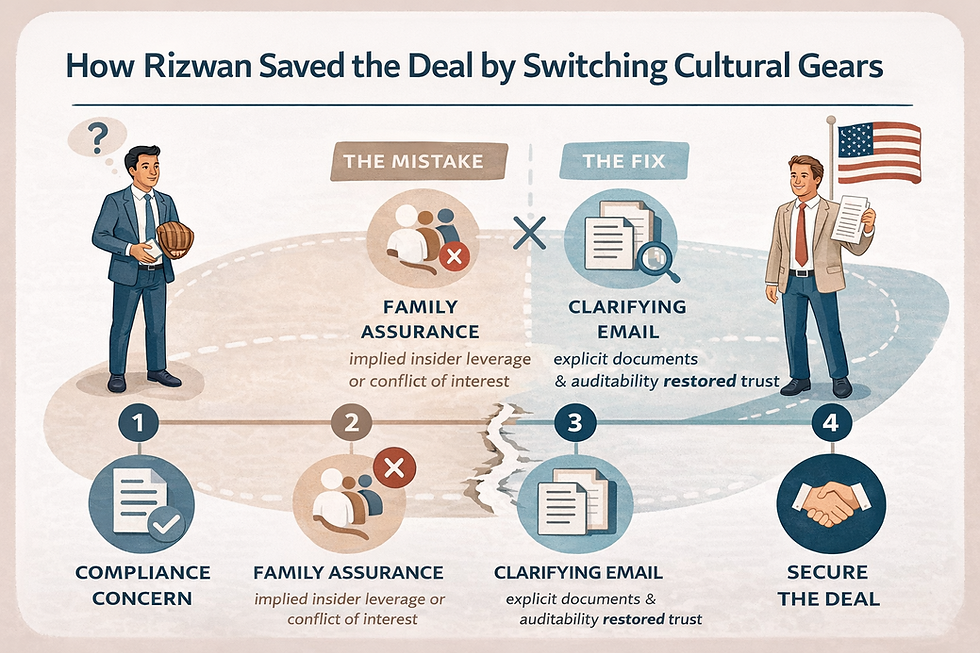
Rizwan responded in a way that is completely normal in relationship-based business cultures like Saudi Arabia, UAE, and Qatar. He explained that compliance would be handled personally by his cousin, and he referenced his cousin’s standing and family reputation to emphasize reliability.
In Rizwan’s cultural operating system, that’s a trust signal.
In the American corporate operating system, it can sound like the opposite.
In the U.S., especially where regulation and safety codes are involved, “my cousin is handling it” can land as a potential conflict of interest. It can sound like someone is bypassing the process. And “inside baseball,” depending on context, can imply insider leverage or working around standard rules.
Even if that isn’t what you mean, that’s what the American buyer’s brain has to protect against. This is the contextual chasm I mentioned in a previous post.
High-context cultures build trust through relationship, reputation, and implied meaning.
Low-context cultures build trust through explicit language, documentation, and process.
In the U.S., the burden of communication is on removing ambiguity. If your phrasing creates legal ambiguity, your intent won’t save you.
Rizwan wanted to “smooth things over.” I referred him back to one of our sessions on ambiguity together and he he quickly remembered it's more about a simple delivery shift. So that's what he did.
Rizwan followed up with clarity and professional humility. He clarified that his cousin wasn’t informally “handling compliance.” His cousin is the lead Director on the Regulatory Compliance board overseeing the certification process.
Then he did the one thing that consistently restores trust with American buyers.
He showed the work.
He provided the ASME certification documents, pressure test results, and the compliance timeline in plain, explicit language the buyer could forward internally without editing.
That one switch, from relationship-based reassurance to task-based proof, reopened the deal path and closed the sale.
If you’re selling into the U.S., especially in high-stakes environments, you can’t rely on implied meaning. You have to speak in a way that’s defensible, repeatable, and document-centered.
You can still be warm. You just have to be explicit.
I've listed five key friction points you might be facing with your American audience, and a possible solution HERE.

BONUS:
Three phrases that trigger caution in U.S. corporate sales (and what to say instead)
“Don’t worry, it won’t be an issue.” Say instead: “Here’s how we’re handling it, and here are the documents that support it.”
“My cousin is handling it personally.” Say instead: “Our compliance lead is overseeing certification. Here are the ASME documents, test results, and timeline.”
“We can get it through quickly.” Say instead: “We can move fast because the process is already in motion. Here are the checkpoints and expected approval date.”


Comments